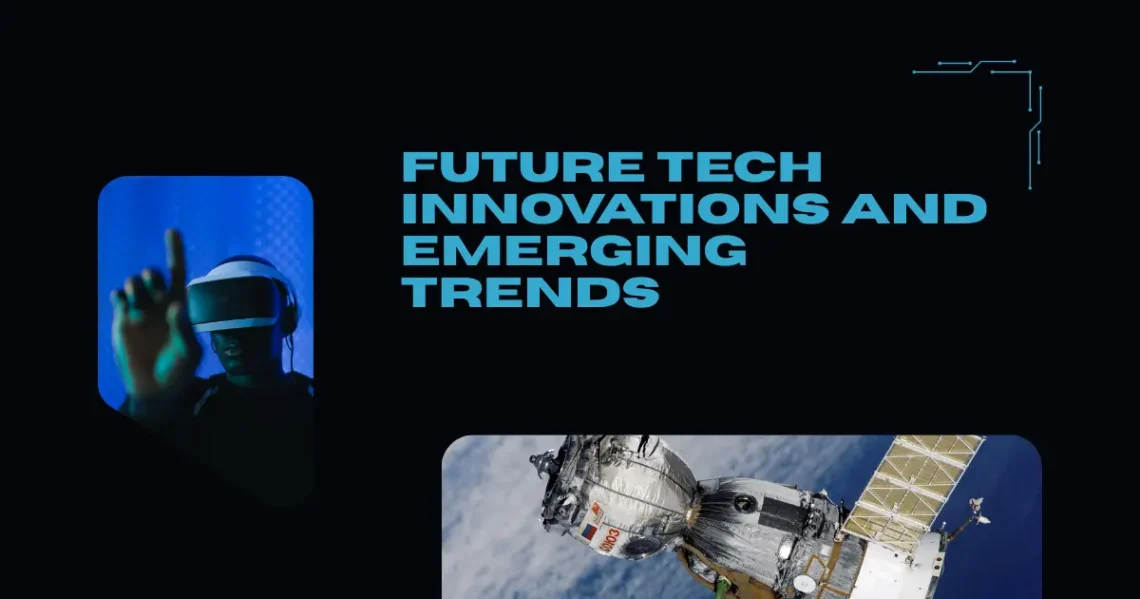

Introduction
When we talk about future tech innovations, the mind instantly races to all those sci-fi movies where robots walk among us, or humans fly cars in neon-lit cities. But the reality of how technology is evolving is both more subtle and, in some ways, even more exciting. Technology isn’t just about shiny gadgets or complicated devices; it’s about solving real human problems in ways that seemed impossible just a few years ago. From how we connect with one another, to how we heal, learn, and even travel, the pace of innovation is so fast that it can sometimes feel overwhelming.
In many ways, the present already feels like the future we once dreamed of. Think about video calls that connect families across continents instantly, or wearable watches that monitor our heartbeats. These things were once wild imaginations but now they’re ordinary. What makes “future tech innovations” fascinating is that we don’t exactly know what’s next. There are predictions, yes, but often breakthroughs come from unexpected corners.
The importance of keeping an eye on future technology isn’t just for businesses or tech lovers. It’s for everyone. Why? Because these changes affect the way we live daily life—our jobs, our health, even the food we eat. And while there’s excitement, there’s also nervousness: Will machines take away work? Can we trust devices with our private information? These are questions people quietly carry in the back of their minds.
So, as we dive into the world of upcoming innovations, think of it less like a distant dream and more like a wave that’s already reaching the shore. The best we can do is stay aware, curious, and maybe even a little prepared for what’s about to reshape our world.
Artificial Intelligence and Machine Learning
Artificial intelligence (AI) and machine learning (ML) are probably the first things that come to mind when people talk about future tech innovations. It feels like every other day there’s news about how AI is transforming some industry or solving problems in ways we didn’t think were possible before. At its core, AI is about teaching machines to think, learn, and sometimes even “decide” like humans. Machine learning takes it a step further, allowing these systems to improve themselves without needing to be reprogrammed every time.
Now, that sounds a little intimidating at first, right? Some folks worry about robots replacing jobs or machines becoming “too smart.” And while those are fair concerns, the reality is more balanced. AI isn’t only about replacement—it’s often about support. Imagine doctors having an assistant that can analyze thousands of medical scans in minutes, highlighting potential risks they might have overlooked. Or students having access to personalized learning programs that adjust to their pace and style. These are examples of AI not taking away from humans but empowering them to do better work.
Businesses too are leaning into AI and ML for predictive insights. Retail companies use them to understand what people might want to buy next, while banks detect suspicious activities within seconds to prevent fraud. And even in our daily lives, whether we notice it or not, AI is already deeply integrated—think of spam filters in email, virtual assistants on your phone, or those eerily accurate recommendations on streaming platforms.
Still, with all these advancements, there are ethical debates. How much should machines know about us? Can algorithms be biased? These are questions we’ll have to grapple with as AI grows. But overall, it’s hard not to feel a little amazed by how fast and how far these technologies are moving.
AI in Everyday Devices
If you pause for a moment and look around your home, you might be surprised to realize just how many everyday devices are quietly running on artificial intelligence. It’s not always flashy robots or futuristic machines—sometimes it’s as simple as the phone in your pocket or the speaker sitting on your shelf. These tools have gradually blended into our routines, so naturally that we almost forget they’re powered by something as advanced as AI.
Take smart assistants like Alexa, Siri, or Google Assistant. You talk to them casually, asking about the weather or setting an alarm, and they respond in a natural, almost human-like way. Behind that simplicity is complex AI, constantly learning your voice, habits, and preferences. Over time, they even start to predict what you might want—like suggesting when to leave for work because traffic is heavy, or reminding you about a package that’s arriving soon.
Another clear example is in our smartphones. From facial recognition to unlock your device, to predictive text while typing a message, AI is working in the background. Even the camera filters that enhance your selfies are driven by machine learning algorithms trained on millions of images. And of course, streaming apps recommending your next favorite movie or playlist are also part of this invisible AI ecosystem.
At home, AI powers smart thermostats that learn your heating and cooling preferences, robotic vacuum cleaners that map your floor plan, and even refrigerators that can alert you when groceries are running low. These aren’t luxuries anymore—they’re becoming everyday realities.
But here’s the interesting part: as helpful as these devices are, they also raise new questions. How much personal data do they need to function? And are we comfortable giving them that access? While the convenience is undeniable, finding the right balance between comfort and privacy is part of the ongoing conversation around AI in our daily lives.
AI in Healthcare and Medicine
One of the most exciting areas where AI is making a difference is healthcare. For decades, medicine has relied heavily on the skills and judgment of doctors, which is still the most important part of treatment. But now, with AI stepping in, healthcare is entering a whole new phase. What makes it fascinating is how machines can process enormous amounts of data in seconds—something even the best doctors can’t realistically do on their own.
Think about medical scans, for instance. Radiologists spend hours looking at X-rays, MRIs, and CT scans. AI-powered tools can scan through thousands of images in just minutes, highlighting possible tumors or abnormalities that might otherwise be overlooked. It’s not about replacing doctors but giving them sharper eyes and quicker insights, which could literally save lives.
Another area is predictive diagnostics. By analyzing patient histories, genetic information, and lifestyle data, AI can suggest who may be at higher risk for certain conditions. Imagine being able to predict diabetes or heart disease years before symptoms even show up. That early warning could completely change how diseases are treated or even prevented.
Drug discovery is another game-changer. Traditional methods take years, sometimes decades, to develop new medicines. AI can simulate how different compounds will interact with the body, drastically cutting down the time needed to identify potential cures. This became especially clear during global health crises, where speed mattered more than ever.
Of course, there are concerns. Privacy of medical records is a big one, and patients often wonder: who has access to this sensitive data? Also, if an AI system makes a mistake, who takes responsibility? These challenges are real, but the potential is so great that many experts believe AI in healthcare will become as common as stethoscopes in the future.
Quantum Computing and Its Impact
Quantum computing might sound like one of those complicated scientific concepts that only researchers in labs can understand, but its potential is too big to ignore. At its heart, quantum computing is about using the principles of quantum physics to process information in ways that traditional computers simply can’t. Instead of relying on simple bits (0s and 1s), quantum computers use qubits, which can exist in multiple states at once. This means they can handle calculations at speeds that would take normal computers thousands, maybe even millions, of years.
Now, this isn’t just about making your laptop faster or downloading a movie in a second. The true impact of quantum computing lies in solving problems that are currently impossible or extremely time-consuming. For example, think about climate modeling. Today’s computers can only make estimates, but a quantum computer could simulate Earth’s atmosphere with breathtaking accuracy, helping us predict and tackle environmental changes more effectively.
In industries like finance, quantum machines could analyze market risks in real time, giving investors more precise insights. In healthcare, they could process complex biological data to speed up drug discovery and find cures for diseases much faster than before. Even logistics companies could use quantum computing to design routes that save massive amounts of fuel and time.
Of course, with all this potential, there are challenges too. Quantum computers are still in their early stages, and building them is no small feat. They require extreme conditions, like super-cold temperatures, to function properly. And then there’s the worry about cybersecurity—quantum machines could one day break through today’s strongest encryptions, raising new questions about how safe our data will be.
Still, despite the hurdles, the progress being made suggests quantum computing won’t stay in science labs forever. It might just reshape the very foundation of technology and society in the years to come.
Quantum in Healthcare
When people hear the word “quantum,” their minds usually jump to physics or complex science theories. But in reality, one of the most promising uses of quantum computing is actually in healthcare. This is because medicine often involves dealing with huge amounts of information—genes, proteins, chemicals, patient histories, and more. Traditional computers can process some of this, but they struggle with the sheer scale and complexity. Quantum computers, on the other hand, are built to handle exactly that kind of problem.
One of the most exciting possibilities is drug discovery. Normally, it can take years, even decades, to test how molecules interact with each other and whether they might work as medicine. A quantum computer can simulate these interactions in ways classical computers can’t, reducing the time needed drastically. Imagine speeding up the development of life-saving drugs for cancer, Alzheimer’s, or rare genetic diseases. That’s a real possibility with quantum tech.
Another area is personalized medicine. Every human body is unique, and treatments that work for one person may not work for another. Quantum computing could help analyze genetic data at a much deeper level, allowing doctors to tailor treatments that match an individual’s exact biology. This could mean fewer side effects, more effective therapies, and a higher chance of recovery.
Even hospital operations could benefit. Quantum systems could optimize how resources like ICU beds, equipment, and staff are allocated, reducing waiting times and improving patient care.
But of course, it’s not all smooth sailing. Quantum computers aren’t widely available yet, and building them is incredibly costly and complex. Plus, healthcare already faces challenges around privacy and data security—something that will need even stricter protection in a quantum-powered world. Still, the potential here feels too big to ignore, and it’s likely we’ll see early breakthroughs in the coming decades.
Quantum in Cybersecurity
Cybersecurity is already a tricky field, and with the rise of quantum computing, it’s going to change even more. Today, most of our online world—whether it’s banking apps, private emails, or government data—is protected by encryption. This basically means that information is locked using mathematical puzzles that are extremely hard for classical computers to crack. But here’s the catch: those same puzzles that take a traditional computer thousands of years to solve could be broken by a powerful quantum computer in a matter of hours, maybe even minutes.
This idea sounds a little scary, doesn’t it? If quantum computers fall into the wrong hands, the security of almost everything we store online could be at risk. Passwords, personal details, company secrets—all of it could become vulnerable. That’s why cybersecurity experts are already working on what’s called “post-quantum cryptography.” It’s essentially a new generation of digital locks designed to be secure even against the power of quantum machines.
On the flip side, quantum computing can also strengthen cybersecurity. With its ability to process data on a massive scale, it can help detect cyberattacks much faster than current systems. Instead of reacting after damage is done, organizations could prevent breaches in real time. Quantum key distribution (QKD), for instance, is a technique where information is sent using quantum particles like photons. If someone tries to intercept the message, the particles change, and the intrusion is immediately detected. That’s a level of security classical methods can’t match.
Of course, the transition won’t be simple. Building practical quantum cybersecurity tools is still in progress, and not every organization is ready to adopt them. There’s also the question of cost—small businesses may struggle to keep up. But as quantum tech grows, so will the need for stronger defenses, making cybersecurity one of the most critical areas of innovation in the years ahead.
Sustainable and Green Technologies
As exciting as futuristic gadgets and space travel sound, one of the most urgent areas for innovation is actually much closer to home—our planet. The pressure to find sustainable and green technologies has never been greater. Climate change, pollution, and resource shortages are problems affecting every corner of the world, and technology is increasingly being looked at as part of the solution. Instead of just making life more convenient, these innovations are designed to make life possible for future generations.
One key area is renewable energy. Solar panels, wind turbines, and hydroelectric systems aren’t new, but they’re getting smarter, cheaper, and more efficient every year. For example, new solar materials are being developed that can generate power even on cloudy days or through windows. Energy storage is another critical piece—without effective batteries, even the cleanest energy source becomes unreliable. That’s why breakthroughs in battery technology, like solid-state batteries or hydrogen fuel cells, are so important.
Beyond power, sustainable technologies are reshaping how we live in cities. Think about smart buildings that adjust lighting, heating, and cooling automatically to save energy, or urban planning that integrates greenery to absorb carbon and reduce heat. Even small things, like sensors that detect water leaks or manage waste collection, add up to big improvements when scaled across communities.
Agriculture, too, is being transformed. Vertical farming, precision irrigation, and lab-grown meat are all examples of innovations designed to feed a growing population without destroying ecosystems.
Of course, the path isn’t without obstacles. Green technologies often face high upfront costs, making them less accessible to poorer regions. There’s also resistance from industries tied to fossil fuels. But momentum is shifting. As people demand cleaner alternatives and governments push for climate goals, sustainable tech is quickly moving from an option to a necessity.
Smart Cities and Green Infrastructure
When people imagine “smart cities,” they often think of futuristic skylines filled with flying cars and glowing neon lights. But in reality, the idea of a smart city is much more practical—and honestly, much greener. It’s about designing urban spaces that use technology to make life easier while also reducing the strain we put on the planet. With the world’s population rapidly moving into cities, this concept is becoming less of a dream and more of a necessity.
At the heart of smart cities is efficiency. Imagine buildings that automatically adjust heating and cooling systems based on the number of people inside, saving both energy and money. Streetlights that dim when no one’s around, then brighten as a car or pedestrian approaches. Waste bins that send alerts when they’re full, so garbage trucks only make trips when needed. These might sound like small improvements, but multiplied across an entire city, they add up to massive energy savings and less pollution.
Green infrastructure is another key element. This doesn’t just mean adding more parks, though that’s certainly part of it. It also includes things like rooftop gardens that reduce building temperatures, walls covered in vegetation that clean the air, and systems that capture rainwater to prevent flooding. Together, these create healthier environments for people while also giving nature a place within urban landscapes.
Transport is also a big focus. Electric buses, shared bicycles, and self-driving shuttles are all being tested in cities around the world to cut down on emissions and traffic jams. And when all of these systems are connected through smart networks, cities can respond in real-time—whether it’s redirecting traffic during a storm or adjusting power use during peak hours.
Of course, building smart cities isn’t cheap, and some communities worry about losing privacy with so many sensors and data systems. Still, the overall vision is clear: cities that are cleaner, safer, and more livable for the people who call them home.
Clean Energy Innovations
Clean energy is one of the biggest hopes for a sustainable future, and the innovations happening in this space are nothing short of inspiring. For decades, people have known that fossil fuels are harmful to the environment, yet shifting away from them hasn’t been easy. That’s where new technologies are stepping in—making clean energy more efficient, affordable, and practical for everyday use.
Solar power is a perfect example. In the past, panels were bulky, expensive, and didn’t work well in cloudy weather. Now, researchers are developing thin solar films that can be placed on windows, walls, or even clothes, turning almost any surface into a power source. Some panels are even capable of generating electricity at night by capturing residual heat from the day. It sounds futuristic, but many of these technologies are already being tested.
Wind energy has also evolved. Traditional turbines are being replaced by sleeker, more powerful designs, including vertical-axis turbines that can work in tighter urban spaces. Offshore wind farms, placed far out at sea, capture stronger and more consistent winds, delivering massive amounts of power without crowding land.
Then there’s hydrogen power, which has been called the “fuel of the future.” Hydrogen can be used in vehicles or to store excess energy from renewable sources, providing a backup for when the sun isn’t shining or the wind isn’t blowing. Alongside this, battery technology is racing ahead—solid-state batteries, for example, promise longer lifespans and faster charging than what we currently use.
Of course, challenges remain. Clean energy systems require large investments up front, and in some places, politics and old industries slow down progress. But the momentum is shifting. As costs keep dropping and climate concerns grow louder, clean energy innovations are moving from being optional experiments to becoming the backbone of our future power supply.
Conclusion
Looking at all these future tech innovations—from artificial intelligence to quantum computing, clean energy, biotechnology, and even space exploration—it’s clear we’re heading into a time where the possibilities are almost endless. Technology is no longer just about making things faster or more convenient; it’s about reshaping how we live on a fundamental level. Whether it’s helping doctors save lives, finding ways to protect our planet, or pushing the limits of human travel beyond Earth, these innovations are writing the next chapter of human history.
But, as exciting as it all sounds, it’s not without its share of questions and concerns. Every new advancement brings both opportunities and responsibilities. AI may make life easier, but it also raises issues about privacy and job security. Quantum computing could revolutionize industries but also threatens current systems of cybersecurity. Even clean energy, while crucial, faces challenges in affordability and adoption. The point is, future tech isn’t just about what’s possible—it’s also about how wisely and fairly we choose to use it.
What stands out most is that technology is not happening in some distant future—it’s happening right now, all around us. The smart devices in our homes, the rise of renewable energy, and the beginnings of space tourism are signs that the future is unfolding in front of our eyes. The best way forward is to stay curious, adapt to changes, and make sure that progress benefits as many people as possible, not just a select few.
So, when we talk about future tech innovations, we’re not simply talking about machines or gadgets. We’re talking about our future as people, communities, and a planet. And while no one can predict exactly where it will all lead, one thing feels certain: the next decades will be some of the most transformative in human history.
FAQs
Q1: What are future tech innovations?
Future tech innovations are new and emerging technologies that aim to transform how we live, work, and interact—like AI, quantum computing, clean energy, and biotechnology.
Q2: Why are future tech innovations important?
They help solve global challenges such as climate change, healthcare needs, and connectivity, while also improving daily life and efficiency.
Q3: Which industries will benefit the most?
Healthcare, finance, education, transportation, and energy are expected to see the biggest impacts, though nearly every sector will be touched.
Q4: Are there risks with future technologies?
Yes. Privacy issues, job loss from automation, cybersecurity threats, and high costs are some of the concerns that come with rapid innovation.
Q5: How can individuals prepare for future tech?
Staying informed, learning new skills, and being adaptable are the best ways to prepare for the changes future technologies will bring.